
Stonehenge 2005 summer solstice

News

Feb 2012 - Churchyard surveys

With the completion of our survey work at Littleton Drew churchyard, we look back at what we have learnt about the evolution of the churchyard from the medieval to the modern period. The work was required due to the need to find space for future burials within what appeared to be an area almost completely filled with monuments.

The approach was to map as many monuments as possible using Penmap with our GPS system and to fill any gaps using our Topcon total stations. The monuments were to be represented as either lines or polygons dependent upon their type and the likely position of the burial was indicated using a 'skeleton icon'.

Littleton Drew churchyard

What became clear during the course of the survey work was how a churchyard develops and changes through time with the trends, tastes and beliefs of the period. The earliest monuments at Littleton Drew date to the 18th century and these consist of headstones with occasional footstones to the south of the church and grand chest tombs on the eastern side. The majority of the monuments are Victorian and are often formed of a headstone and surrounding kerb, also occasionally with a footstone.  One can detect an attempt to impose some regularity and order within the Victorian period.

Of note was the orientation of the burial and headstone inscription. Up until about the mid twentieth century most burials appear to stick to a near east - west orientation though confusingly, the inscription may be on either side of the of the headstone. Many of the more recent burials pay little regard to the traditional east - west alignment and the inscription appears to always be on the burial side of the headstone. Presumably many of these later burials are placed so as to infill any gaps in the churchyard and orientation becomes a minor factor.

The recent memorials appear more diverse in that there are graves with simple markers of metal or wood, plaques associated with cremations and more traditional headstones. Several 20th century graves (presumed) were marked by small piles of limestone only. These almost unmarked graves, and evidence of earthworks hinting at other older graves that either never had a memorial or subsequently had a memorial removed, highlight the problems of finding new space without disturbing burials; in a churchyard with medieval origins this is almost inevitable.

What was also apparent was the weathering of the monuments and the durability of the stone types. Early markers appear to be made of Ooltic Limestone which is the most local solid geology. Many Victorian monuments appear to be constructed of Carboniferous Sandstone, originating about 10 miles to the west of the church. Unfortunately the latter appears to frequently split due to its laminar nature.

The completed survey work stopped short of creating a GIS but the advantages of storing data this way may be of interest. Each memorial could easily be linked to text or an image of the epitaph, description of condition, type of stone, style, photograph, etc.


Jan 2012 - Ridge and furrow surveys

Ok, so this may not be everybodies 'cup of tea' but for many years we've been analysing what happens when magnetometry is carried out across ridge and furrow. What kicked this off was the realisation that ridge and furrow was not well understood and that our data was sometimes being misinterpreted during evaluation excavation.

Magnetic anomalies caused by ridge and furrow vary considerably. It depends on whether there are extant earthworks, where the magnetometer was balanced across those earthworks, what the magnetic characteristics of the soil and subsoil are, what has happened after the system has fallen out of use, whether infill material has been bought in, whether the system has drifted or changed in orientation through time and so on. Without comparison to topographic data or carrying out measurements to extant ridge and furrow in the field, it is often not possible to confidently state whether a positive or negative linear anomaly relates to a ridge or a furrow.

Occasionally, ridge and furrow may assist in the determination of superimposition of anomalies.

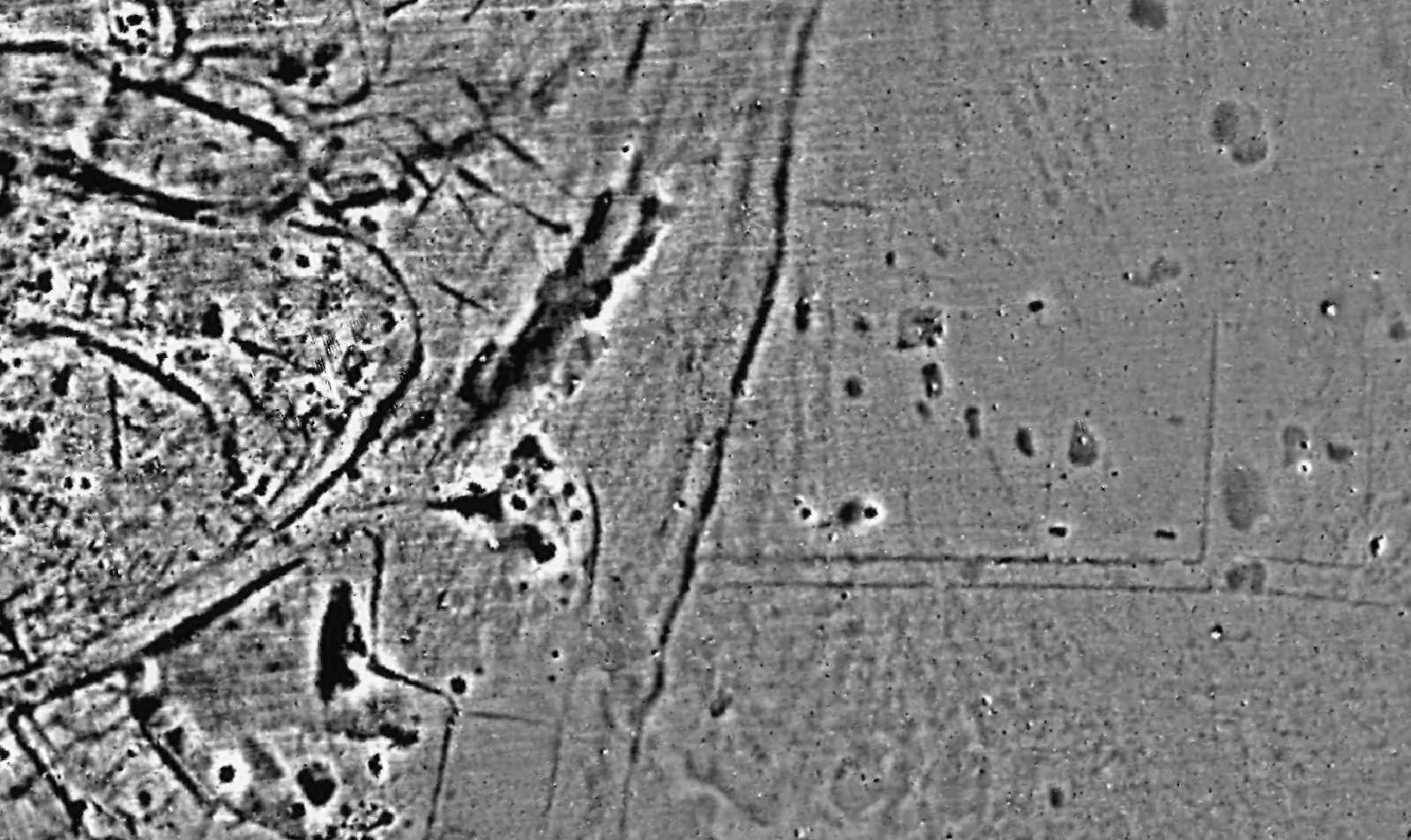
Ridge and furrow cutting through archaeology at TysoeHere is a greyscale plot of magnetometry data from Tysoe in Warwickshire. The furrows of the former ridge and furrow can be seen as light grey linear stripes running from top left to bottom right across the image. These stripes represent negative anomalies that correlate with former furrows no longer visible in the field. A series of Roman and Saxon features (mainly former ditches showing as positive anomalies in black) have been preserved underneath the former ridges. Excavation and fieldwalking in this part of the country often reveals archaeology surviving only as a series of strips with complete truncation of features along the furrows. So the fragmented dashed lines we see within data may well infer features that are older than the establishment of the ridge and furrow.

In the case of the above site it is interesting that we have good pottery evidence from fieldwalking for Saxon activity, a recently found sherd belonging to a cremation urn. There is also evidence of a substantial stone built Roman building. The ridge and furrow itself demonstrates classic reverse S shaped development suggesting that it is ancient, and the field lies immediately adjacent to extant early medieval buildings. Perhaps there has been a shift in the settlement pattern sometime between the 7th and 10th centuries?


Nov 2011 IfA Geophysics Special Interest Group AGM

The GeoSIG AGM was held on November 18th. The following meeting provided an opportunity for a useful discussion about archiving, common standards, health and safety etc. The group was informed of the workshop session at next years IfA Conference.

David Sabin hopes to be able to input to the GeoSIG with regard to health and safety issues and standardisation of reporting (or not!). Archaeological Surveys Ltd consider health and safety issues are a top priority, and there are certainly some unique risks that field workers in archaeological geophysics face.

In the south of the UK in particular, we are often exposed to deer ticks and we have been going on about the risks involved with tick bites for a number of years. David suffered from Lymes Disease as a result of a tick bite and we know a number of individuals who are under long term treatment for Lymes. There are probably countless others that carry on undiagnosed at present.

Another significant risk that seems to rumble on from year to year is gun sports. Despite efforts to obtain and maintain communication with land owners and people who shoot on their land, we find we are exposed to this risk several times a year. It's always a result of a break down in communications - land owners often do not seem to know the movements and precise activities of those they have given permission to shoot and they often don't seem to have regular and rapid communication with them. In the winter months, surveys often start in the dark and finish in the dark - dawn and dusk seem to be the high risk periods.


Nov 2011 - Battle of Newbury I, English Civil War
Civil War lead shot

One of our most recent jobs has been a metal detector survey within a small portion of the Newbury Registered Battlefield. The location was known, from historical records, to have been a clash between parliamentarian and royalist cavalries. Fierce fighting ensued with a major artillery show down between the two sides.


The survey area was very small, only 30m x 30m, and we located 7 lead shot. Measurements suggest the majority are somewhat smaller than those used in muskets and they are more typical of a shorter, lighter firearm used by the cavalry - the carbine. The finds tend to support the historical evidence for cavalry actions in the area.


Analysis of the shot has revealed that most have been distorted, some severely, by impact proving that they were used in anger and possibly at close range.


Nov 2011 - Truckle Hill Roman Villa

More survey work at Truckle Hill Roman villa has revealed an additional Roman building well to the south of the known villa complex. This was a bit of a surprise and we will have to wait until next year before we can carry out further excavation to find out exactly what survives. Additional GPR work proved all but useless as the damp clayey soil prevented radar penetration beyond just a few centimetres at 400MHz; that said, we can just about trace a substantial wall for about 8m or so.


Resistive survey, after heavy rain in early November, has proved quite effective although sorting out exactly what we have found is tricky. We certainly have a response to a substantial wall and a number of cut features but the full extent of the Roman building is uncertain.Truckle Hill prehistoric 'cross dyke'


Combining data from magnetometry, resistivity and GPR survey is helping to piece together fragments of a substantial building that was previously completely unknown. It's a good example of where no one technique is truly effective but by testing the three main techniques we are starting to see some real value in the geophysical interpretation.

The ditch shown here is located to the south of the Truckle Hill villa and is considered likely to be a prehistoric 'cross dyke' that effectively cuts off the end of a hill plateau. It was sampled for magnetic susceptibility measurement at 5cm intervals. Using a Bartington MS2B, mass specific magnetic susceptibility was measured at high and low frequencies. The results suggest the initial fill is moderately enhanced and this is unusual; typically primary fills contain a large proportion of subsoil or solid geology that quickly erodes out of the ditch sides or adjacent bank. In this case, the primary fill is a more developed topsoil but it's unclear as to why this may be so.


Oct 2011 - WWI prisoner of war camp


Magnetometer survey was carried out at the site of a WWI prisoner of war camp in Wiltshire. The work forms part of a pilot project ahead of the centenary of the start of the war. The results demonstrated a good correlation between zones of magnetic debris and the location of former prisoner of war huts.

We are hoping to be able to input more into the project in the future as we have built up a portfolio of WWI sites through survey in Belgium, France, Salisbury Plain and a number of early airfields.

It's fascinating making the link between our surveys carried out over the trenches of the front line and our work over the prisoner of war camps where there is no longer any evidence on the ground. Field walking and metal detection surveys carried out by volunteers have provided further evidence in the form of small objects such as buttons and badges.